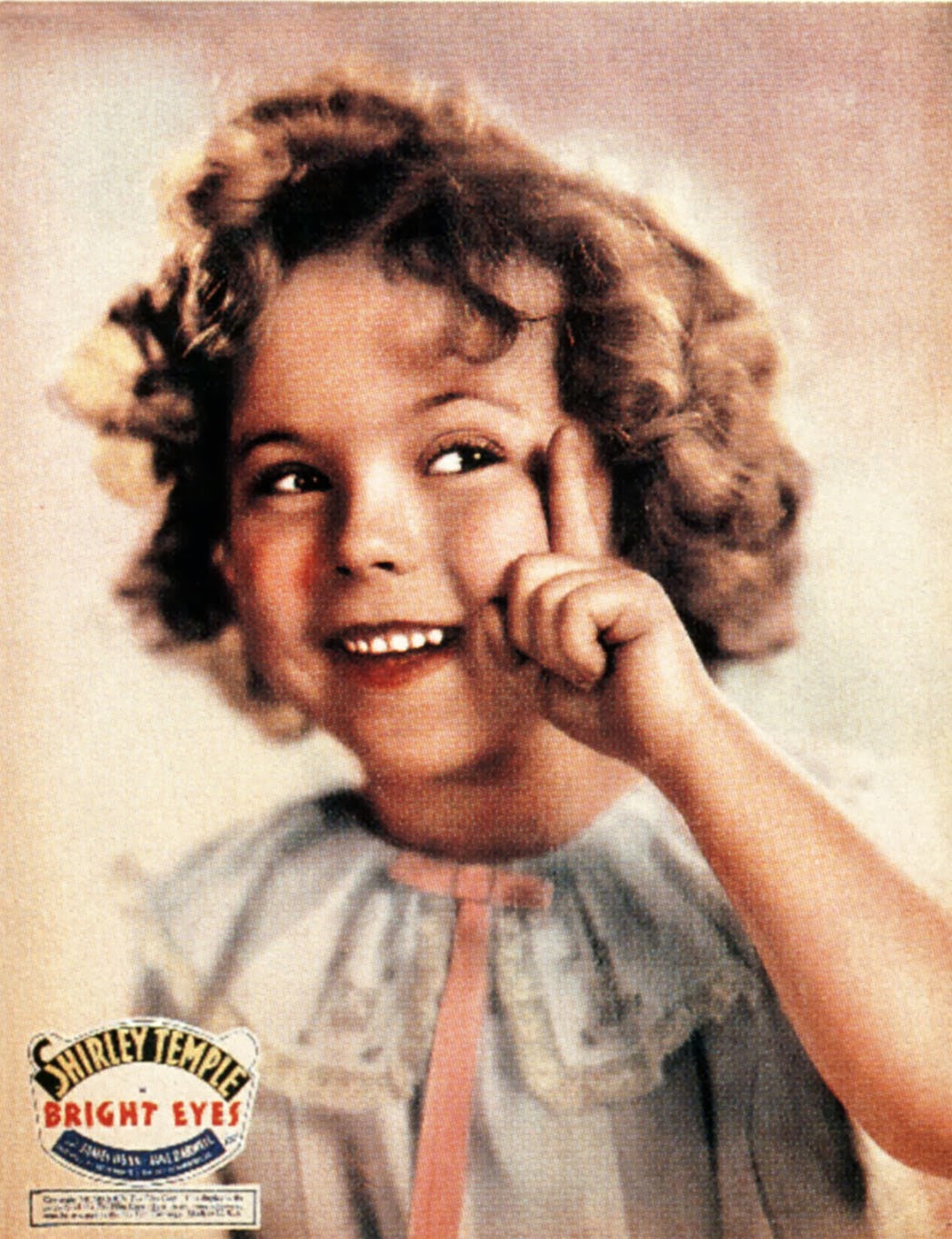
Showing posts with label Shirley Temple. Show all posts

Monday, February 17, 2014

Mixology — Shirley Temple by another name

Shirley Temple

When I was a kid, we had fewer than 500 TV channels. Gasp, I know. So I watched a lot of old movies that broadcast channels often ran to fill time, particularly at night and on the the weekends. Had an old black and white TV next to my bed.

Among those flicks, I saw several Shirley Temple films. I can't say they were my favorites. I enjoyed a little more gangster gun play and world warfare. But her appeal and talent were pretty obvious.  And for a 1970s-80s kid like me, watching  a movie featuring 1930s kids was like being transported to another dimension.

But, upon hearing news of Shirley Temple Black's death this week, her movies weren't my first thought. It was that original mocktail that bears her name, and a little story that gives it a special place in our family lore.

In case you didn't know, a Shirley Temple, the drink, is basically ginger ale, 7 up or something similarly lemon-limey, a splash a grenadine and a maraschino cherry. Some folks like an orange slice, or some orange juice added in. There's a dispute over which bar invented the drink for Ms. Temple's enjoyment. She told NPR's Scott Simon that it was the Brown Derby. Others say a hotel in Hawaii.

I'm not much of a Shirley Temple drinker myself, but I enjoy the antique subversiveness of it, akin to those packs of chalky candy cigarettes my friends and I used to roll up in our T-shirt sleeves. It's a drink for kids that is intended to mimic a potent adult cocktail, the old fashioned. That's the sort of notion, if introduced today, that would draw some very heavy and earnest tut-tutting.

Shirley Temples, after all, could be a gateway drink. Today, it's an innocent dash of grenadine. Tomorrow, Vodka Sam.

And nowadays, it's the adults in backwards caps, grabbing a can of Amp, pretending to be adolescents.

But the Shirley Temple lives on. A few years ago, when our daughter, Ella, was 4 or 5, we slid into a booth at local Red Lobster, a restaurant that our kids love. They love crab legs. They love those Cheddar Bay biscuits/gut-bombs. And the love the lobster tank.

Despite those clear attributes, Ella was cranky. To cheer her up, my wife suggested that she order a Shirley Temple. A big fan of the fizzy, syrupy stuff, Ella was all in. And she was determined to order the Shirley Temple herself.

We talked about Shirley Temple. She practiced a bit. And then the waiter came to take our drink orders. The moment of truth.

"I want a Charlie Niblett," Ella said, proudly.

Who? What? Ya got me. We're still uncertain where this Charlie Niblett came from, exactly. Ella doesn't even know.

We cleared things up for the confused waiter, and she got her Shirley Temple. She's ordered several since then, correctly. But in our family, ginger ale, grenadine and a cherry will always be known as the Charlie Niblett. No offense to Shirley.

This is not all that unusual. Just this morning, Ella asked for a breakfast of French biscuits. I knew instantly that she meant English muffins. Someday, she may start an international incident.

And it may be hereditary. Once during the mid 90s, I was out with my folks at a restaurant in Iowa Falls, around the time the fizzy, sweet malt beverage called Zima was launched. My mom wanted to try one. When the waitress came, she ordered up a "Zippy." I swiftly translated, and all was well.

So mom and Ella are kindred spirits. I'll drink to that. And long live Shirley and Charlie.

This article originally published at The Gazette

The Truth About Shirley Temple's "Wizard of Oz" Connection

This week we mourn the loss -- and celebrate the legacy -- of Shirley Temple Black, an international entertainment icon, and one of the very last surviving mega-stars of Hollywood's golden age. All of Ms. Temple Black's obituaries reference her connection to the 1939 film classic The Wizard of Oz, and told how she was the "first choice" to play Dorothy. Shirley Temple did in fact have an Oz connection, but one that requires clarification in lieu of urban mythology.

As a child star, Shirley Temple was an extraordinary prodigy with unaffected, charismatic charms, photographic memory for lines, lyrics and dance steps, and a radiant crown of golden curls that punctuated her on-screen jubilance or discord with a nod of her dimpled face. Public fascination with Shirley was borderline fanatical at the height of her mid-to-late 1930s popularity, and countless newspaper and magazine articles highlighted her off-camera activities.

Among Shirley's oft-cited literary favorites was The Wizard of Oz book series by L. Frank Baum and his posthumous successor, Ruth Plumly Thompson. In pictorial layouts of the Temple home, the Oz books were clearly visible on her bedroom shelf, and references were made to her interest in the adventures of Dorothy and her friends. In Child Star, her 1988 autobiography, Temple Black herself claimed that when her mother suggested she could play Dorothy in the movies, Shirley replied that she wanted to meet Dorothy, so absorbed was she in the Oz stories.

Shirley was under contract to Twentieth Century-Fox and its studio chief Darryl F. Zanuck was vigilant in scouting suitable story properties that could be developed for his most valuable player. Zanuck was aware of The Wizard of Ozas an ideal vehicle for Shirley as early as 1935 when rumors about Temple playing Dorothy began cropping up. One such notice informed readers that Shirley would star in a series of Oz movies -- not as wild as it sounds when one considers that Zanuck bought up the Muriel Dennison Susannah books after Shirley scored a hit with Susannah of the Mounties in 1939. Buzz about Shirley in The Wizard of Oz persisted into 1937.

In Child Star, Temple Black recalled that in 1937, while making the movie Heidi, she learned of a negotiation proposed between Fox and Metro-Goldwyn-Mayer that involved loaning her to MGM for a Wizard of Oz production. In exchange, Metro would loan Fox its two biggest stars, Clark Gable and Jean Harlow. According to legend, the deal fell through when Harlow died on June 7, 1937. At the time, MGM did not own the film rights to The Wizard of Oz, and the anecdote has often been dismissed as apocryphal. But in spring 1937 -- and before Harlow's death -- Oz appeared on a list of top books recommended for big-screen versions, many of which were made within the next five years. If ever there was a time for the old Hollywood chestnut about both studios engaging in discussion about a mutual star-swap, this would've been it.

Confusion about Shirley playing Dorothy has arisen because the alleged events of 1937 have become blurred with the events of MGM's developing Wizard of Oz production in 1938. Having secured the screen rights from movie mogul, Sam Goldwyn, in February 1938, Metro set about casting its big-budget opus. From the very start, Judy Garland (then fifteen-years-old) was approved to play Dorothy by producer-director, Mervyn LeRoy, and song lyricist and aspiring producer, Arthur Freed. After all, Metro's Wizard of Oz was going to be a musical, and Judy's brilliant singing prowess already had a public following. Though Judy was set for the part, Nicholas Schenck, head of Loew's Inc. (MGM's controlling parent company since the previous January), felt box-office security in the person of Shirley Temple was needed to ensure a financial return against Oz's big budget.

Roger Edens, MGM composer and Garland's mentor, dubiously made an appointment to hear Shirley Temple sing on the Twentieth Century-Fox lot. He returned to Metro to report that Temple lacked the robust vocal chops required for the extravaganza being prepared, and the part of Dorothy remained Judy Garland's, as intended. On the occasion of her April 23, 1938 birthday, the press noted that Shirley Temple's missing out on Dorothy was "the greatest disappointment of her brief and eminently griefless career..." In 1941, Temple's mother, Gertrude, remained bitter when she recounted that Zanuck had deceived her: He had assured her that Fox owned the Wizard of Oz film rights.

Zanuck cast Shirley in a series of classic children's stories adapted for the screen culminating in The Blue Bird in 1939 -- a Technicolor musical that, like The Wizard of Oz, opens in sepia-tones before converting to color for a lengthy fantasy sequence. Oz was a hit, but The Blue Bird was the first Shirley Temple picture to lose money. It marked the close of her magnificent career as the world's premier child actress -- a distinction that most critics would agree is still upheld today.

In the end, Shirley Temple Black proved to be a gracious and good sport. As she herself noted years later with regards to Judy Garland getting the role of Dorothy, "Sometimes the gods know best."

For more fun facts and fascinating trivia, check out the new book The Wizard of Oz: The Official 75th Anniversary Companion.


This article originally published at THE HUFFINGTON POST
   

Wednesday, February 12, 2014

Patty Duke remembers Shirley Temple, opens up about pressure for child stars

Patty Duke ruled the 1960s, winning an Academy Award for Best Supporting Actress at 16 for The Miracle Worker and later starring in her eponymous sitcom. Starting her career at just 7, Duke has unique insight into the life of a child star, and the specific challenges they face as they grow up in the public eye. Duke opened up about those struggles in her memoir, Call Me Anna, which showed how she overcame her own difficult obstacles.

Patty Duke
 
With the sad news that perhaps the most famous child star of all time, Shirley Temple, passed away Monday night, EW spoke with Duke to discuss Temple's influence on her, her own on-set experiences, and why she thinks so many child stars struggle once they hit adulthood. Note: Twitter isn't helping.

I don't know a whole lot about Shirley Temple's home life or background to get what we saw on film. Except, having been almost in her shoes I know that that little girl worked hours and hours and hours and I hope somebody treated her very kindly. Every mother wanted their daughter to be Shirley Temple. I had very straight hair and my mother used to drive me crazy curling my hair so that I could look like Shirley Temple. Didn't work [Laughs] 
I know that the child labor laws have really progressed since her time. We have moved along, partially from the Screen Actors Guild [Duke was president of the guild from 1985 to 1988], and partially from the pressure we have put on the various states to make sure there are rules about the number of hours children can work. I started working at 7. My first job I was an extra in Somebody Up There Likes Me, which starred Paul Newman. My brother was also an extra, he was in charge of me. I just did what my brother told me to do and it was exciting — all of this equipment and people all around!
Over my career, I've worked with people spanning five generations, including Laurence Olivier, Gloria Vanderbilt and Richard Burton. What I remember is one little gesture of kindness from them [made a big difference to me]. I also remember paying really good attention to what they did. Stealing from the best! [Laughs] My opinion: Actors as a whole are very kind people, especially with child actors, and they give them a lot of love.
I used to say I'd never put a kid in show business, but then I learned to never say never. It worked for my son [Sean Astin]. It's been a wonderful experience for him, working now for almost 30 years. He had parents who made sure they were paying attention to what was going on on set and just his basic good behavior. Child actors get very inflated because people want things from them and are paid special kind of attention, and then the kid turns 10 and that goes away. It's difficult to adjust to that. But Sean has made that transition beautifully. Knowing what I know now, I hope I would not have missed the experience of these 60 years [by not starting my career young]. For me, there has been some ugly down times, some okay times, and there has been ecstasy.
The [former child stars] who are now in their early 20s break my heart. I've followed just as a viewer what has been happening with them and I wanted to reach out, and yet I was afraid that it might be misunderstood coming from someone who is completely open about mental illness; it might frighten them more. So I haven't. I love them, I understand their pressures, and I can't believe how grateful I am that my illness was caught before I took that last drink or that last whatever. I'm the lucky one. And I believe that they will find that too. It's very hard to get help when everyone on Facebook and Twitter is giving their opinions and critiques. We like to say "We don't pay any attention to any of that," but that's not true. We're people. When somebody says something about you, it hurts. And who knows? Maybe in these cases it fuels the sickness even more.
As a child, I idolized Shirley the movie star. My favorite Shirley Temple movies were the ones that had her incredible singing and dancing and dimples, but then she'd do a scene that was serious and I would be sobbing for days. The mold had been broken. There was only one Shirley Temple. But look, she'll live on: When we go to a restaurant, my grandchildren order a Shirley Temple.
- As told by Patty Duke

This article originally published at PopWatch

Related Articles:
 

My Shirley Temple

My sadness at Shirley Temple's death has to do with the reminder of that far-gone time when I was her fan.

In the early nineteen-eighties, in Grand Rapids, Michigan, Shirley Temple movies were shown on Sunday mornings, on cable TV. When we got our first VCR, in 1982, my father would set the timer to record the movie, and it would be waiting for me and my younger sister when we got home from church. Sometimes, he would stay home from church so that he could use what we called "the pause control" to excise the commercials. Even then, at age nine, I knew that this had as much to do with his love for us (and for new technology) as it did with his ambivalence about church.

I adored Shirley Temple. I wanted to be a child star, and, even nearly a half century after the height of her stardom, Shirley seemed to me to be the paradigm of one. I knew that she was the youngest person ever to win an Oscar (though this fact was asterisked, because it was a special children's Oscar, not a real one), and that during the Depression she had been a top-grossing performer. I knew that her stand-in was named Mary Lou Isleib, and that Shirley had been considered for Dorothy in "The Wizard of Oz." I knew that she'd had trouble transitioning into roles for young women; that she'd had an early, brief first marriage and a longer second one, during which she'd had breast cancer and had become the Ambassador to Ghana. I knew all this, and more, because I read everything I could about Temple, including two books that remain on my shelves: Robert Windeler's "The Films of Shirley Temple," its spine now white, its cover still hot pink, and "The Shirley Temple Story," a silver-jacketed hardcover I bought in the biographies section at Schuler Books on Twenty-eighth Street.

While I liked Shirley's movies, I wasn't especially moved by the story lines or the interactions between characters (with the exception of "The Little Princess," in which Sara Crewe desperately searches the wards of the wounded soldiers for her father). I was stirred by Shirley herself—stirred by the fact of this little girl onscreen. There was enormous power in watching her doing what I wanted to do—a little girl who I knew had been at the center not only of these films but also of the culture. There was something about the movies being old that mattered, too. There was a feeling of discovery, a feeling that Shirley was mine.

I rarely revisit Shirley's movies as an adult, and no doubt if I did all kinds of weird stuff would pop up, including lots of daddy issues (often, he's missing), and, also, what is up with the slave-owning family in "The Littlest Rebel"? If Shirley was sexually objectified, I didn't pick up on it; to me, her wholesomeness was part of her appeal. My mother said that Shirley was one of the few child stars who had grown up to be normal, meaning both that her life had not turned into a soap opera or a tragedy, and that she seemed to have made the choice to leave Hollywood behind.

In our back yard, I belted Shirley's songs the same way I belted the songs from Annie. In fourth grade, I sang "At the Codfish Ball," from "Captain January," in the school talent show. That was the same year I wrote Shirley a letter. Some weeks after I sent the note, I received one from her, a three-by-five card on which, in black ink, she wrote a few short lines and signed her name, "Shirley Temple Black." My mother put the card in a Lucite frame that I placed on my dressing table.

My sadness at hearing of Shirley Temple's death has much to do with the reminder of that far-gone time when I was her fan. When I was nine, my parents were still married (four years later, they divorced); I was still their little girl in my original house. My parents indulged my Shirley Temple interest. One day after school, my mother took me to a dark, musty used bookstore I'd found in the Yellow Pages. I also loved Judy Garland, and the proprietor of the store told me, "I have a another customer just like you, someone who is interested in those same two, Shirley Temple and Judy Garland." I still sometimes think about this person in Grand Rapids who was my double.

The year I was nine, I received a set of newly reissued vinyl Shirley Temple dolls for Christmas. But my favorite present was something my father bought for me in a used-book store in Ann Arbor, on the other side of the state. Used-book stores were my father's churches, and at this one, the Dawn Treader, he'd found a Shirley Temple scrapbook from the nineteen-thirties. Onto its blank pages, someone from that same era—it seemed to me like a woman, because the work was too neat for a little girl—had pasted articles about Shirley Temple that she'd scissored out of movie magazines and local Michigan newspapers. I felt I knew this woman somehow, knew her across time and across the state, knew the thrill of a fellow-fan opening the newspaper to see a story about her favorite star. I was amazed that my father had found this scrapbook in a mysterious store with a fantasy-novel name, and I was moved that he had known what its stiff pages and yellowed articles would mean to me. It's a very Shirley Temple-movie ending, a moment of tenderness between a daughter and a father, but what can I say? I still have that scrapbook.

Susan Burton's memoir, "The Invention of the Teenage Girl," will be published next year by Random House.

Shirley Temple, 1928. Photograph by Hulton Archive/Getty.

This article originally published at The New Yorker

Shirley Temple: Her Career in Pictures

The musical child star -- noted for her glowing corkscrew curls and heartwarming songs that uplifted America from the throes of the Great Depression -- died on Monday, Feb. 10 at her Woodside, Calif. home at age 85.

Stand Up and Cheer! (1934)

Temple made her feature debut in Hamilton McFadden's musical Stand Up and Cheer! She only had a small part in that movie -- the plot sees the U.S. government creating a "Department of Amusement" to shake the nation from its Depression doldrums -- but the picture quickly made Fox realize what a valuable asset it had on its hands and went on to save the studio from bankruptcy.

Stand Up and Cheer

Bright Eyes (1934)

Temple captivated moviegoers with her furrowed brow, perplexed pouts and unrelenting cheeriness in Bright Eyes, the David Butler-directed picture in which she played an orphaned godchild caught in a custody battle. She memorably belted out her signature song, "The Good Ship Lollipop," and the sheet music then sold a half-million copies.


Bright Eyes

Oscar Winner (1935)

The Academy of Motion Picture Arts and Sciences presented Temple at age 6 with the first Juvenile Academy Award "in grateful recognition of her outstanding contribution to screen entertainment during the year 1934." She is the youngest person ever to receive an Oscar statuette, miniature or otherwise.

Oscar Winner

Curly Top (1935)

In the musical directed by Irving Cummings, Temple plays a sweet but trouble-making orphan adopted by a wealthy bachelor, who then falls for her older sister. It is in Curly Top that Temple sings her classic, "Animal Crackers in My Soup."

Curly Top

The Little Colonel (1935)

Once again directed by David Butler, The Little Colonel is the Civil War musical drama in which Temple tap-danced with Bill "Bojangles" Robinson on a staircase in one of the most enchanting cinematic sequences of all time. In her first of four onscreen pairings with Robinson, Temple plays Lloyd Sherman, the estranged granddaughter of Colonel Lloyd -- though the two bond as the rest of their family reconciles.


Heidi (1937)

Directed by Allan Dwan, Heidi is the big-screen adaptation of Swiss author Johanna Spyri's children's tale. The hit cast Temple as the title character, who is taken from her grandfather to befriend a bratty invalid.

Heidi

An Oscar for Walt Disney (1939)

Temple, the top child star at the time, was chosen to present Walt Disney with a special honorary award for Snow White and the Seven Dwarfs. She memorably handed him a full-sized Oscar statuette, with seven miniature Oscar statuettes descending in a row.

An Oscar for Walt Disney

A Little Princess (1939)

In the film loosely based on the Frances Hodgson Burnett tale, Temple reprises another orphan character, this time as a boarding school student who is mistreated when her father is lost at war. Directed by Walter Lang, it was the first of her movies to be filmed completely in Technicolor.

A Little Princess

Adventure in Baltimore (1949)

Temple married John Agar (seven years her senior) in 1945 when she was 17, in a Los Angeles wedding that attracted thousands of her fans. They had a daughter, Linda, and Agar became an actor, appearing with Temple in Richard Wallace's Adventure in Baltimore. But troubled by his excessive drinking and constant flirtations, Temple filed for divorce in 1949 and retired from acting. She then wed Charles Black in 1950; they had a son, Charles, in 1952 and a daughter, Lori, in 1954.

Adventure in Baltimore

Temple Hits TV

Temple's last professional affiliation with show business was in the late 1950s and early '60s, when she hosted and sometimes starred in Shirley Temple's Storybook and The Shirley Temple Show on television. She then went on to try a run for Congress and act as a U.S. delegate to the United Nations, a U.S. ambassador to Ghana and Czechoslovakia and as the State Department's chief of protocol. She also published her best-selling autobiography, Child Star, and received Kennedy Center honors and the Screen Actors Guild's Life Achievement Award.

Temple Hits TV

This article originally published at The Hollywood Reporter

Related Articles:

Shirley Temple's Hollywood Walk of Fame Star in Storage

Repairs were being made to the Vine Street location where the star would have been.
Shirley Temple

The timing of Shirley Temple's death has forced a change in the tradition of placing flowers at a Hollywood Walk of Fame star when an honoree dies.

Story: Legendary Child Star Shirley Temple Dies at 85

Hollywood Chamber of Commerce spokeswoman Ana Martinez says Temple's star is in storage while repairs are being made to the Vine Street location where it would normally be embedded in the sidewalk.

Instead, the chamber will place flowers Tuesday morning on the center divider of Hollywood Boulevard at La Brea Avenue, which is considered a gateway to the Walk of Fame.

Video: Shirley Temple's 7 Memorable Movie Roles

As a child star, Temple was America's top box-office draw from 1935 to 1938 and she was inducted into the Walk of Fame on Feb. 8, 1960.

Temple died Monday night at her home near San Francisco at age 85.

This article originally published at The Hollywood Reporter

Shirley Temple: 7 Memorable Movie Roles (Video)

The enchanting singing-and-dancing child star died Monday night of natural causes at her Woodside, Calif., home, surrounded by her family and caregivers.
  
Shirley Temple
Shirley Temple, the enchanting singing-and-dancing child star with the glowing corkscrew curls who saved a Hollywood studio and helped yank America from the throes of the Great Depression, died Monday night of natural causes at her Woodside, Calif., home, surrounded by her family and caregivers. She was 85.

Making $1,250 a week at age 6, the incandescent Temple was a veteran of 46 features and one-reelers before she turned 13. With the country still reeling from the Great Depression, President Franklin Roosevelt proclaimed, "As long as our country has Shirley Temple, we will be alright." Her films were always filled with boundless optimism and an uncanny ability to melt the hardest of hearts.

The Academy of Motion Picture Arts and Sciences presented Temple at age 6 with the first Juvenile Academy Award "in grateful recognition of her outstanding contribution to screen entertainment during the year 1934." She is the youngest person ever to receive an Oscar statuette, miniature or otherwise.

The Hollywood Reporter highlights the most memorable roles from Temple's heartwarming career.

Bright Eyes (1934)

Temple captivated moviegoers with her furrowed brow, perplexed pouts and unrelenting cheeriness in Bright Eyes, the picture in which she played an orphaned godchild caught in a custody battle. She memorably belted out her signature song, "The Good Ship Lollipop," and the sheet music then sold a half-million copies.


Little Miss Marker (1934)

Little Miss Marker put Temple onstage -- and atop a piano -- for a memorable performance of "Laugh, You Son of a Gun" with Dorothy Dell. Temple's character is a "marker" held by gangsters after her father loses a bet.


The Little Colonel (1935)

The Little Colonel is the Civil War drama with music in which Temple tap-danced with Bill "Bojangles" Robinson on a staircase in one of the most enchanting cinematic sequences of all time. In her first of four onscreen pairings with Robinson, Temple plays Lloyd Sherman, the estranged granddaughter of Colonel Lloyd -- though the two bond as the rest of their family reconciles.


Our Little Girl (1935)

In the final feature from director John S. Robertson, Temple plays Molly Middleton, a young girl who runs away from home after her parents grow apart and announce their divorce. The film also stars Joel McCrea and Rosemary Amesas her parents.


Curly Top (1935)

In the musical directed by Irving Cummings, Temple plays a sweet but troublemaking orphan adopted by a wealthy bachelor, who then falls for her older sister. It is in Curly Top that Temple sings her classic, "Animal Crackers in My Soup."


The Littlest Rebel (1935)

The Littlest Rebel cast Temple and Robinson together again, this time to appeal to President Lincoln for help in another Civil War saga. Their onscreen reunion features another memorable tap-dance sequence.


A Little Princess (1939)

In the film loosely based on the Frances Hodgson Burnett tale, Temple reprises another orphan character, this time as a boarding school student who is mistreated when her father is lost at war. It was the first of her movies to be filmed completely in Technicolor.


This article originally published at The Hollywood Reporter


Shirley Temple Dead: Legendary Child Star Dies at 85

UPDATED: "We salute her for a life of remarkable achievements," a statement from the actress' family read in part, asking for privacy as they prepare funeral arrangements.

 Shirley Temple

Shirley Temple, the enchanting singing and dancing child star with the glowing corkscrew curls who saved a Hollywood studio and helped yank America from the throes of the Great Depression, died Monday night. She was 85.

Temple died of natural causes at her Woodside, Calif., home surrounded by her family and caregivers, said a statement from her agent.

VIDEO: Shirley Temple's 7 Memorable Movie Roles

Temple recently had begun receiving hospice care, her nephew, Richard Black, told The Hollywood Reporter.

Making $1,250 a week at age 6, the incandescent Temple was a veteran of 46 features and one-reelers before she turned 13. A huge star in a pint-sized package, she received an average of 16,000 letters a month, and for one birthday, fans sent her 167,000 presents. She was the subject of a Salvador Dali surrealistic painting, and a nonalcoholic drink garnished with a maraschino cherry was invented and named after her so kids and adults could "imbibe" together.

A bigger box-office draw than Clark Gable (another actor with famous dimples), Temple captivated moviegoers with her furrowed brow, perplexed pouts and unrelenting cheeriness in such films as Bright Eyes (1934), in which she belted out her signature song, "The Good Ship Lollipop."

"On the good ship Lollipop, it's a sweet trip to a candy shop. Where bon-bons play, on the sunny beach of Peppermint Bay," she sang. The sheet music sold a half-million copies.

With the country still reeling from the Great Depression, President Franklin Roosevelt proclaimed, "As long as our country has Shirley Temple, we will be all right." Her influence extended to lands far away: Looking to curry favor with America, foreign dignitaries sent her such gifts as a miniature, drivable Rolls-Royce (from the Aga Khan in the Middle East) and a kid-size jade elephant (from China).

STORY: Shirley Temple Death: Hollywood Mourns Child Star

The Academy of Motion Picture Arts and Sciences presented Temple at age 6 with the first Juvenile Academy Award "in grateful recognition of her outstanding contribution to screen entertainment during the year 1934." She is the youngest person ever to receive an Oscar statuette, miniature or otherwise.

Temple appeared in six other features that year, including the musical Stand Up and Cheer! She only had a small part in that movie -- the plot sees the U.S. government creating a "Department of Amusement" to shake the nation from its Depression doldrums -- but the picture quickly made Fox realize what a valuable asset it had on its hands.

On the verge of bankruptcy and tens of millions of dollars in debt, Fox merged with Twentieth Century Pictures in 1935, and studio chief Darryl F. Zanuck made the adorable tot his No. 1 priority. He put the finest talent on the lot to work on her pictures, and the Shirley Temple Development Division at one time employed 19 writers.

Four of Temple's most memorable films were released in 1935, including The Little Colonel, a Civil War musical drama where she tap-danced with Bill "Bojangles" Robinson on a staircase in one of the most enchanting cinematic sequences of all time.

She followed up that year with Our Little Girl and Curly Top -- which introduced another of her songs that became a classic, "Animal Crackers in My Soup" -- and The Littlest Rebel, in which she and Robinson appeal to President Lincoln for help in another Civil War saga.

A gold mine with glowing locks -- her mother Gertrude did her hair for each movie, with 56 corkscrew curls each time -- the plucky Temple was No. 1 at the box office for four straight years, from 1935 through 1938. During this stretch, Fox reworked her contract to pay her $50,000 per film.

After Temple was loaned out to Paramount in 1934 for the films Now and Forever with Gary Cooperand Carole Lombard and Little Miss Marker, Zanuck made certain that would never happen again. He refused to let her work at MGM on The Wizard of Oz (1939), and the part of Dorothy went to Judy Garland.

STORY: Shirley Temple's Hollywood Walk of Fame Star in Storage

The studio saw monstrous earnings from Temple's pictures, with the girl endorsing such products as dresses, cereal and soap. Her dolls sold at a rate of 1.5 million a year. She lost her innocence, or at least her belief in Santa Claus, "when my mother took me to see him in a department store, and he asked for my autograph," she once said.

In a 1988 interview with People magazine, she admitted she didn't realize how famous she was.

"I really didn't know it," she says. "When I asked my mother why crowds shouted my name and said, 'We love you,' she would dust it off by saying, 'Your work makes them happy.' She never let it go to my head."

Shirley Jane Temple was born in Santa Monica on April 23, 1928. Her father, George, was a banker, and her mother was a homemaker. She had two older brothers. Her mom claimed that her baby's very first words were a lyric to aRudy Vallee song, and she enrolled her incredibly bright daughter in dance school.

In 1932, the 3-year-old Temple appeared in the first of her eight Baby Burlesks one-reelers -- parodies of movie hits or current events that had tykes in roles made famous by adults. At age 5, she signed with Fox, meteorically ascending from contract player to full-fledged star after Stand Up and Cheer played theaters.

The studio kept its biggest star sheltered in her own bungalow on the lot in an effort to preserve her natural childlike charm. "If I lost my innocence," she recalled a studio exec telling her, "it would show in my eyes." Her films were always filled with boundless optimism and an uncanny ability to melt the hardest of hearts.

PHOTOS: Hollywood's Notable Deaths of 2014

Temple graduated to starring in well-regarded literary adaptations such as Wee Willie Winkie (1937), directed byJohn Ford. From 1937 to 1940, she toplined such films as Heidi, Rebecca of Sunnybrook Farm, Little Miss Broadway, the Technicolor gem The Little Princess, The Blue Bird (Fox's answer toThe Wizard of Oz) and Young People.

Those last two films, though, were flops. Soon, Mickey Rooney, another youngster, was king of the box office, and Fox and Temple ended their association in 1940. Her parents placed the 12-year-old Temple in a school for girls, and she eventually signed a contract with MGM.

As a teenager and young adult, she starred in the World War II drama Since You Went Away (1944);The Bachelor and the Bobby Soxer (1947) opposite Cary Grant and Myrna Loy; Ford's Fort Apache(1948) with John Wayne andHenry Fonda; and her final feature, A Kiss for Corliss (1949) with David Niven.

Temple's last professional affiliation with show business was in the late 1950s and early '60s, when she hosted and sometimes starred in Shirley Temple's Storybook and The Shirley Temple Show on television.

Temple married John Agar (seven years her senior) in 1945 when she was 17, in a Los Angeles wedding that attracted thousands of her fans. They had a daughter, Linda, and Agar became an actor, appearing with Temple in Fort Apache and Adventure in Baltimore (1949). Troubled by his excessive drinking and constant flirtations, Temple filed for divorce in 1949 and retired from acting.

Months after the divorce was finalized, Temple met Charles Black at the Outrigger Club while on a Hawaiian vacation in Waikiki. A San Francisco businessman and former naval officer, Black confessed to her that he had never seen any of her movies. He proposed 13 days after they met, and they wed in Carmel Valley, Calif., in December 1950. They had a son, Charles, in 1952 and a daughter, Lori, in 1954.

Black died in their Woodside home of bone marrow disease in August 2005, and Temple's nephew, Richard, said she was lonely ever since. All three of her children also survive her.

PHOTOS: Shirley Temple's Career in Pictures

A Republican, Temple unsuccessfully ran for Congress in 1967 on a platform supporting America's involvement in the Vietnam War. A year later, President Nixon appointed her a U.S. delegate to the United Nations. She later served as the U.S. ambassador to Ghana and Czechoslovakia and as the State Department's chief of protocol.

In 1972 at age 44, Temple was one of the first public figures to talk about having a mastectomy, paving the way for open discussion of a formerly taboo health subject. "It is my fervent hope that women will not be afraid to go to doctors for diagnosis when they have unusual symptoms," she said then.

In 1988, Temple published her best-selling autobiography, Child Star, and received Kennedy Center honors. She accepted the Screen Actors Guild's Life Achievement Award in 2006 but stayed out of the public eye in her final years.

"When I was 3 years old, I was delighted to be told that I was an actress, even though I didn't know what an actress was," she said to much laughter at the SAG presentation.

"I have one piece of advice for those of you who want to receive the Lifetime Achievement Award: Start early!"

A statement from Temple's family read in part, "We salute her for a life of remarkable achievements as an actor, as a diplomat and most importantly as our beloved mother, grandmother, great-grandmother and adored wife for fifty-five years of the late and much missed Charles Alden Black…. We ask that our family be given the opportunity at this time to grieve privately."

Private funeral arrangements for Temple are still pending but a remembrance guest book will soon be opened at shirleytemple.com. Contributions in her memory may be made to the Commonwealth Club of California's 2nd Century Campaign or to the Education Center at the Academy Museum of Motion Pictures in Los Angeles, according to the family's statement.

This article originally published at The Hollywood Reporter